

Wilt Chamberlain1961 Fleer In Action Card #47

Wilt Chamberlain 1970 Topps Card #50

Wilt Chamberlain 1977-79 Sportscaster Card #07-20 Italy

Topps 1971 Wilt Chamberlain
Card #70

Topps 1971 NBA Rebound Leaders Card #142

Topps 1972 Wilt Chamberlain All Star Card #168

Topps 1969 Wilt Chamberlain Card Card #1


This photo was taken by SI's Walter Iooss, Jr., during an NBA playoff game on April 5, 1968, just 24 hours after Dr. Martin Luther King, Jr. had been assassinated.

Visit Wilt's page on Basketball Reference. There you can see his career regular and postseason statistics, including his game logs, box scores of every game in which he played, and his career splits. Here is where you can visit Wilt's page at The Naismith Basketball Hall of Fame.

Wilt Chamberlain: A View From Above

Sports Illustrated: October 16, 1972

Sports Illustrated: April 12, 1965

Pro Basketball Almanac: October 26, 1967
When One Man Ruled the Game: Revisiting Wilt Chamberlain's Astonishing Career
By Rob Olds
The North Texas Sports Blog
February 23, 2026
If I could somehow fine a time machine and choose an athlete to see play, Wilt Chamberlain would undoubtedly be my top choice (along with Lou Gehrig). At 7'1" and 275 pounds, Wilt was bigger than life. In a 1986 Sports Illustrated article written about Wilt at the time of his 50th birthday, Senior Writer Frank Deford put it best: "Wilt was so big, he blocked out the sun".
If Wilt were graduating from Philadelphia's Overbrook High School in today's NIL era, he likely would skip playing in college and go straight to the NBA. No colleges could afford to pay him, and his talent would be NBA-ready. College would not be a big enough challenge.
When Wilt was recruited by colleges in high school, he received more than 200 scholarship offers. Virtually every major college basketball program in the country tried to land him, along with several schools that didn't have strong basketball traditions.
Kansas Jayhawks
Wilt arrived at Kansas in 1956 and immediately became the most unstoppable force in college basketball. On December 3, against Northwestern, he exploded in his collegiate debut with 52 points (breaking the previous school mark of 44) and 31 rebounds (shattering the previous school record of 24), in an 87-69 win over the Wildcats. Over two seasons, he averaged 29.9 points and 18.3 rebounds per game. As a sophomore, he led Kansas to the NCAA championship game, where they lost in triple overtime to North Carolina. Wilt scored 23 points and pulled down 14 rebounds while being named the Final Four Most Outstanding Player, one of the rare times the award went to a player on the losing team.
Leaving Early
His junior year was statistically just as dominant, but the season was overshadowed by constant double-and triple-teams, racial hostility in some road environments, and the emotional fallout from Phog Allen's forced retirement. In June 1958, Wilt announced that he would leave Kansas after his junior year and play professionally with the Harlem Globetrotters before entering the NBA.
Wilt Chamberlain Enters the NBA: A New Era Begins
When Wilt Chamberlain finally stepped onto an NBA court in 1959, the league wasn’t ready. College coaches had schemed, triple‑teamed, and stalled the ball just to keep it out of his hands. The Harlem Globetrotters had showcased his athleticism and charisma. But the NBA — a league still finding its identity — was about to meet a player who would redefine what dominance looked like.
A Rookie Season That Didn’t Feel Real
Wilt didn’t ease into professional basketball. He detonated onto the scene. On October 24, 1959, in his NBA debut with the Philadelphia Warriors against the New York Knicks, Wilt poured in 43 points with 28 rebounds while shooting 17-for-27 from the field (63%) and 9-for-15 from the line (60%) in 48 minutes.
His big night was an omen of things to come. His top 5 scoring games as a Rookie included 58 points @ New York Knicks (2/21/60) and vs. the Detroit Pistons (1/25/60), 55 points @ the Cincinnati Royals (11/12/59), 53 points vs. the Boston Celtics (2/23/60), and 52 points vs. the Minneapolis Lakers (1/5/60).
In his Rookie year, Wilt led the league with:
-
37.6 points per game
-
27.0 rebounds per game
-
Rookie of the Year and MVP — in the same season
No one had ever done that. No one has done it since. His combination of size, speed, and stamina made him feel like a player from a different era dropped into 1959 by accident.
Instantly the League's Center of Gravity
Wilt changed the NBA landscape immediately. From the moment he joined the Philadelphia Warriors, every team had to rethink how they played. Coaches redesigned defenses. Teammates adjusted their roles. The league itself would eventually change rules — widening the lane, revising offensive goaltending, and altering inbounding procedures — all because of Wilt.
He wasn’t just a star. He was a structural challenge.
Wilt vs. Russell: The Rivalry That Built the Modern NBA
Before television money, before superteams, before the NBA became a global brand, there was Wilt Chamberlain and Bill Russell — two giants whose collisions didn’t just decide championships, but defined what greatness meant in professional basketball. Their rivalry wasn’t a subplot to Wilt’s career; it was the central tension that shaped an entire era.
board and run the court as fast as a gazelle.
In his first game against Russell and the Boston Celtics, Wilt scored 30 points and grabbed 30 rebounds, while Russell scored 22 points and had 35 rebounds. The Celtics won, 115-106. Both behemoths went nuclear on the glass and set the tone for a rivalry that would intensify over the next decade.
Wilt Chamberlain vs. Bill Russell -- Career Head-To-Head Stats
Wilt Chamberlain and Bill Russell met 94 times across the 1960s, a decade-long collision between the sport’s most overwhelming force and its greatest winner. In those match ups, Wilt delivered staggering individual production — averaging 30.0 points, 28.2 rebounds, and nearly 4 assists per game — while Russell countered with 14.2 points and 22.9 rebounds, anchoring a Celtics machine built on depth, defense, and relentless execution.
The statistical contrast was dramatic, yet the results tilted toward Boston: Russell’s teams went 57–37 in the regular season and 29–20 in the playoffs, including multiple series that shaped the NBA’s early identity. Their rivalry was never simply about numbers; it was about philosophy. Wilt was the unmatched physical titan, capable of scoring 50 in a night or grabbing 55 rebounds against Russell himself (Six of Wilt's ten highest single‑game rebounding performances came against Bill Russell and the Boston Celtics), while Russell was the master of team basketball, defensive anticipation, and psychological warfare — famously saying he’d “let Wilt score once in a while” so he wouldn’t awaken the beast. The Celtics surrounded Russell with Hall of Fame talent, while Wilt’s supporting casts fluctuated wildly, forcing him to reinvent himself from unstoppable scorer to league‑leading passer to defensive anchor depending on the team and coach.
Together, they elevated the NBA from a regional curiosity into a national spectacle. Every Wilt–Russell game became an event, the league’s first true marquee rivalry, and their contrasting legacies created the template for every modern GOAT debate: overwhelming individual dominance versus the cold, undeniable currency of winning. Their battles produced two of the greatest teams ever — Wilt’s 1967 76ers and Russell’s 1960s Celtics — and forged a friendship rooted in mutual respect that lasted long after the final buzzer of the 1969 Finals.
More than any pair of players in league history, Wilt and Russell defined what greatness could look like, and their rivalry still echoes through every conversation about championships, leadership, and the soul of the sport.
The 1966-67 Philadelphia 76ers and 1971-72 Los Angeles Lakers
Wilt’s fingerprints are all over two of the most dominant teams the league has ever seen, and what’s remarkable is how different his roles were. With the 1966–67 Philadelphia 76ers, he was the engine of a juggernaut that broke Boston’s stranglehold on the NBA. That team went 68–13, and Wilt was at the center of everything—still scoring efficiently, but now orchestrating the offense as a high‑post facilitator, leading the league in assists by design rather than necessity. He anchored a roster loaded with firepower—Hal Greer, Chet Walker, Billy Cunningham—and yet it was Wilt’s unselfishness, his willingness to reshape his game, that unlocked their full potential. The ’67 Sixers didn’t just win; they overwhelmed teams with a blend of power, pace, and ball movement that felt ahead of its time. When they finally toppled Russell’s Celtics in the Eastern Division Finals, it wasn’t just a playoff victory—it was a symbolic passing of the torch.
Five years later, Wilt reinvented himself again with the 1971–72 Los Angeles Lakers, this time as the defensive backbone and emotional anchor of a team that won 33 straight games and finished 69–13. By then, he wasn’t the scoring machine of his youth, but he didn’t need to be. With Jerry West and Gail Goodrich carrying the offensive load, Wilt became the league’s most intimidating interior presence—controlling games through rebounding, rim protection, and a level of physical dominance that still jumps off the film. His Finals performance that season, playing through injury and outmuscling the Knicks in the paint, earned him Finals MVP and cemented his legacy as the ultimate adaptable superstar. Few players in NBA history have ever shaped championship teams in such dramatically different ways, and that duality—offensive hub in ’67, defensive fortress in ’72—is a huge part of what makes Wilt’s career so singular.

Here is one of my favorite sports photos of all-time. Wilt Chamberlain, seen here as a rookie out of Kansas, is about to play his fourth career NBA game against the center who
would become his biggest nemesis--6'10" Bill Russell of the Boston Celtics
Here they are, shaking hands, on November 7, 1959, just before the first tipoff of their storied rivalry. Russell went on to win 11 titles in 13 years in Boston. He was the ultimate team player, and arguably the greatest defensive player in NBA history. These two heavyweights retired as the top two rebounders in league history--both in total rebounds and average rebounds per game, and are still at the top of the list today.
Individually, though, Chamberlain, at 7'1" and 250 pounds, was a different animal. A track star at Kansas, he had unprecedented athletic ability. He was extremely fast--he ran a 4.3 second forty yard dash, had a 43-inch vertical leap (highest in NBA history), and was arguably the strongest player the league has ever seen (he could bench press 600 pounds). He could pick quarters off the top of the back-


Sports Illustrated: January 27, 1969
Tall Men, Short Shorts by Leigh Montville
Sports Illustrated: May 15, 1972


My autographed photo of Wilt Chamberlain from
March 2, 1962, the night he scored 100 points
against the New York Knicks.
Wilt Chamberlain's Career Resume
Top 20 Accomplishments of Wilt's Hall of Fame Career
1. The 100‑Point Game (March 2, 1962)
Chamberlain set the single greatest scoring record in basketball history by dropping 100 points against the New York Knicks. No player before or since has come within striking distance of this mark. It remains the most iconic individual performance in NBA history.
2. Averaging 50.4 Points Per Game for an Entire Season (1961–62)
Wilt averaged an unfathomable 50.4 points per game across 80 games. This is the most unbreakable scoring record in NBA history. No other player has even averaged 40.
3. Most Points in a Season — 4,029 (1961–62)
Chamberlain became the only player ever to score over 4,000 points in a single season. His total required averaging more than 48 minutes per game. It’s a statistical Everest.
4. Most 50‑Point Games in a Season — 45 (1961–62)
Wilt recorded 45 games of 50+ points in one season. Most players never reach that number in a career. He did it in six months.
5. NBA Record: 55 Rebounds in a Single Game
Against Bill Russell and the Celtics, Wilt grabbed 55 rebounds — a record that has stood untouched for over six decades. It showcased his unmatched physical dominance. No modern player has come remotely close.
6. All‑Time NBA Rebounding Leader — 23,924
Chamberlain retired as the NBA’s career leader in total rebounds. His combination of size, strength, and timing made him the most prolific rebounder ever. His record remains secure.
7. Only Player With Multiple 2,000‑Rebound Seasons
Wilt grabbed over 2,000 rebounds in two different seasons. No other player has done it even once. It’s a testament to his endurance and relentless activity.
8. 11‑Time NBA Rebounding Champion
Chamberlain led the league in rebounding 11 times, the most in NBA history. His consistency on the glass spanned eras, coaches, and systems. He dominated the boards like no one else.
9. Four‑Time NBA MVP (1960, 1966, 1967, 1968)
Wilt won four MVP awards across two different teams and playing styles. His peers and media recognized his unmatched impact. He remains one of the most decorated players in league history.
10. Two‑Time NBA Champion (1967, 1972)
Chamberlain led the 1967 76ers and 1972 Lakers to titles, both considered among the greatest teams ever. His 1967 run is often cited as the peak of his all‑around game. His 1972 title capped a season of historic dominance.
11. NBA Finals MVP (1972)
Wilt won the Finals MVP in 1972, the first year the award existed. He anchored the Lakers with elite defense and rebounding. His performance sealed one of the most dominant playoff runs ever.
12. 13‑Time NBA All‑Star
Chamberlain was selected to 13 All‑Star Games during his 14‑year career. His presence was a fixture of the league’s showcase event. It reflected his sustained excellence.
13. Seven‑Time All‑NBA First Team
Wilt earned seven First Team selections, competing against legends like Russell and Kareem. His all‑around production made him a perennial top choice. He defined the center position for a generation.
14. Led the NBA in Field Goal Percentage Nine Times
Chamberlain topped the league in shooting efficiency nine times. His combination of power and touch made him nearly automatic around the rim. He redefined what high‑percentage scoring looked like.
15. Led the NBA in Assists (1967–68)
Wilt became the only center in NBA history to lead the league in assists (8.6) per game. He did it intentionally to prove he could dominate as a passer. It showcased his versatility and basketball IQ.
16. Most Minutes Per Game in NBA History — 45.8 MPG
Chamberlain averaged more minutes per game for his career than the length of a regulation game. He routinely played every minute, including overtime. His durability was superhuman.
17. Played 48.5 Minutes Per Game in 1961–62
Wilt averaged more than the full game length for an entire season. He sat for only eight minutes all year. No player has ever matched that workload.
18. Rookie of the Year and MVP in the Same Season (1959–60)
Chamberlain won both awards as a rookie, a feat matched by only one other player. He immediately became the league’s most dominant force. His debut season set the tone for a historic career.
19. Two‑Time All‑Defensive First Team (1972, 1973)
Even late in his career, Wilt remained an elite defender. These honors came before blocks and steals were officially recorded. His defensive impact was widely acknowledged by peers and coaches.
20. Hall of Fame Inductee (1978) & NBA 35th, 50th, and 75th Anniversary Teams
Wilt was inducted into the Hall of Fame just five years after retiring. He is one of the few players named to all three major NBA anniversary teams. His legacy is cemented as one of the most singular forces the sport has ever seen.
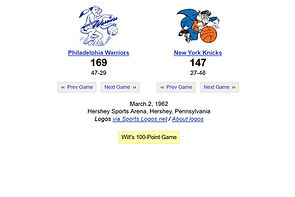
Wilt scored 100 points against the New York Knicks on March 2, 1962, in Hershey, PA. Click on the screen shot above to see the box score on Basketball Reference..


PSA slabbed 8x10 photo autographed by Wilt. Lew Alcindor and Jerry West are also in the photo.

PSA slabbed 8x10 photo autographed by Bill Russell. Russ is pulling down a rebound in a game at the Boston Garden.
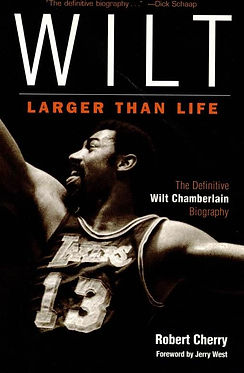
Wilt: Larger Than Life by Robert Cherry

Bill Russell, Wilt Chamberlain, and the Golden Age of Basketball by John Taylor

Wilt, 1962: The Night of 100 Points and the Dawn of A New Era by Gary Pomerantz