
NTSB's Home Ballpark

Dodger Stadium gives the NTSB All‑Time Team a stage worthy of its mythic pitching staff, pairing their power and precision with a ballpark long defined by dominance on the mound. Its sweeping sightlines, timeless architecture, and electric West Coast atmosphere create a sense of grandeur that matches the team’s larger‑than‑life roster. More than a venue, it becomes a cathedral—one where every game feels like a chapter in baseball’s enduring legend.
Interesting Dodger Stadium Facts
-
A true pitcher’s park, Dodger Stadium has long been known for suppressing offense thanks to its deep dimensions, consistent weather, and heavy evening air.
-
Home of 13 No-Hitters. Only a handful of ballparks can match its history of dominant pitching, including two perfect games thrown on its mound.
-
Sandy Koufax’s Masterpiece: Koufax’s 1965 perfect game at Dodger Stadium remains one of the most celebrated pitching performances in MLB history.
-
Kirk Gibson’s Iconic Walk-Off: The 1988 World Series opened with Gibson’s legendary, limping pinch-hit homer — a moment forever tied to the stadium’s lore.
-
Birthplace of Fernandomania: In 1981, Fernando Valenzuela turned the stadium into a cultural phenomenon, drawing massive crowds and electrifying the city.
-
A frequent World Series stage: Dodger Stadium has hosted a dozen Fall Classics, making it one of the most postseason-tested venues in baseball.



A Team For the Ages: Meet the NTSB All-Time Team
By Rob Olds
The North Texas Sports Blog
January 27, 2026
The North Texas Sports Blog All‑Time Team feels less like a roster and more like a myth whispered through generations—a collection of legends forged in some hidden baseball foundry where the laws of the game bend to the will of greatness. The pitching staff rises first, a towering wall of inevitability. Bob Feller hurls thunder from a distant century, Randy Johnson sends sliders screaming out of the shadows, and Nolan Ryan unleashes raw, elemental force that rattles the air itself. Greg Maddux follows with the quiet cruelty of a master surgeon, slicing the strike zone into ribbons, while Tom Seaver and Sandy Koufax bring a regal, unshakable authority to the mound. And should you somehow stagger past this gauntlet, the bullpen awaits like a final judgment—Dennis Eckersley with his icy precision, Mariano Rivera with his single, devastating blade of a cutter, and Goose Gossage with fire in his eyes. They don’t merely defeat you. They take your dignity.
Yet the true terror of this team emerges when the bats come alive. Johnny Bench commands the field with the calm certainty of a general, while Lou Gehrig and Joe Morgan punish every mistake with the inevitability of sunrise. Derek Jeter moves through the infield with the quiet confidence of a man who has broken hearts in Octobers past. Mike Schmidt stands at third like a fortress, his bat capable of turning any pitch into a distant memory. And then the outfield—Hank Aaron, Willie Mays, and Babe Ruth—three titans patrolling the grass, each capable of rewriting the game with a single swing or a single stride. Pete Rose waits in the shadows as the designated hitter, a reminder that even the bench holds thunder. Against this lineup, every inning becomes a trial, every pitch a prayer. They don’t simply win. They envelop you, suffocating every hope until all that remains is the awe of having witnessed baseball immortality assembled in one impossible place.
Meet the NTSB All-Time Team Roster
C – Johnny Bench
Johnny Bench became the standard by which all modern catchers are measured, blending rare power with historically great defense. He won 10 Gold Gloves and made 14 All‑Star teams, anchoring the Cincinnati Reds during the Big Red Machine’s dynasty years. Bench captured two MVP awards, a remarkable feat for a catcher, and led the league in home runs twice and RBI three times. His leadership and clutch hitting helped Cincinnati win four pennants and two World Series titles, including his MVP performance in the 1976 Fall Classic. Bench retired with 389 home runs, the most ever by a catcher at the time, and a reputation for redefining the position’s athletic expectations. He was inducted into the Baseball Hall of Fame in 1989, cementing his place among the greatest players in MLB history.
Memorabilia - My bat signed by Bench and autographed JB baseball.
1B – Lou Gehrig
Lou Gehrig became the embodiment of durability and excellence, anchoring the Yankees’ lineup with a blend of power, consistency, and quiet leadership. He won two MVP awards, drove in 1,995 runs, and posted a career .340 average while forming one of baseball’s greatest duos alongside Babe Ruth. Gehrig played in 2,130 consecutive games, earning the nickname “The Iron Horse” and setting a standard for reliability that stood for more than half a century. His 1927–1937 peak remains one of the most dominant offensive stretches in MLB history, with nine seasons of 150+ RBI. Gehrig’s career was tragically cut short by ALS, yet his farewell speech and grace in the face of illness made him an enduring American icon. He was elected to the Baseball Hall of Fame in 1939, forever remembered as THE greatest first basemen in MLB history.
Memorabilia - A plaque of Lou Gehrig's speech given to the crowd at Yankee Stadium on July 4, 1939, and a figurine of Gehrig depicting him giving the speech.
2B – Joe Morgan
Joe Morgan built one of the most complete résumés in baseball history, pairing elite athleticism with exceptional baseball intelligence. A ten-time All-Star and two-time National League MVP, he was the engine of Cincinnati’s Big Red Machine, driving their back‑to‑back World Series titles in 1975 and 1976. Morgan blended rare power and speed for a second baseman, finishing his career with 268 home runs and 689 stolen bases while redefining what middle‑infield production could look like. His combination of patience and strike‑zone mastery made him one of the toughest outs of his era, leading the league in on‑base percentage and walks multiple times. After his playing days, he became a respected broadcaster, adding another chapter to his influence on the sport. Elected to the Hall of Fame in 1990, Morgan remains widely regarded as one of the greatest second basemen in MLB history.
SS – Derek Jeter
Derek Jeter became the face of the Yankees’ late‑90s dynasty, blending consistency, leadership, and big‑moment poise from the moment he arrived in 1996. He won five World Series titles and delivered some of the most iconic postseason moments in franchise history, including “The Flip” and his Mr. November home run. Jeter collected 3,465 hits, good for sixth all‑time, while batting .310 across a 20‑year career spent entirely in New York. He made 14 All‑Star teams, won five Gold Gloves, and was a fixture at the top of one of baseball’s most successful lineups. His durability and professionalism helped define an era of Yankees baseball built on winning and accountability. Jeter was elected to the Baseball Hall of Fame in 2020 with near‑unanimous support, securing his legacy as one of the greatest shortstops in MLB history.
3B – Mike Schmidt
Mike Schmidt established himself as the greatest third baseman in MLB history through a rare blend of power, patience, and elite defense. He won three MVP awards, led the National League in home runs eight times, and finished his career with 548 homers, the most ever by a third baseman. Schmidt anchored the Phillies’ lineup for nearly two decades and played a central role in delivering the franchise’s first World Series title in 1980, earning Series MVP honors. His combination of Gold Glove defense and middle‑of‑the‑order production made him one of the most complete players of his era. Schmidt’s disciplined approach at the plate produced a .380 career OBP and helped define the modern power‑and‑walk profile. He was inducted into the Baseball Hall of Fame in 1995, securing his legacy as the premier third baseman in MLB history.
LF – Hank Aaron
Hank Aaron built one of the most complete and consistent careers in MLB history, pairing elite power with remarkable durability and professionalism. He finished with 755 home runs, breaking Babe Ruth’s iconic record while also collecting 3,771 hits and driving in 2,297 runs, still the all‑time RBI mark. Aaron made 25 All‑Star teams, a testament to his sustained excellence across three decades. He was far more than a power hitter, posting a .305 career average and delivering Gold Glove defense in right field during his prime. His pursuit of the home run record became a defining cultural moment, and he handled the pressure and hostility with extraordinary grace. Aaron was elected to the Baseball Hall of Fame in 1982, forever remembered as one of the greatest and most respected players in MLB history.
CF – Willie Mays
Willie Mays is widely regarded as the most complete player in MLB history, blending elite power, speed, defense, and instincts into a single transcendent package. He hit 660 home runs, collected 3,293 hits, and won 12 Gold Gloves, all while patrolling center field with unmatched grace. Mays won the 1954 MVP, helped lead the Giants to a World Series title that same year, and remained a dominant force well into his late 30s. His famous “Catch” in the 1954 World Series became an enduring symbol of his athletic brilliance and baseball IQ. Across 22 seasons, he combined highlight‑reel defense with middle‑of‑the‑order production in a way no other center fielder has matched. Mays was elected to the Baseball Hall of Fame in 1979, forever remembered as one of the greatest and most electrifying players the sport has ever seen.
RF – Babe Ruth
Babe Ruth transformed baseball from a low‑scoring, speed‑driven game into a power spectacle, becoming the sport’s first true superstar. He hit 714 home runs, led the league in homers 12 times, and retired with a career 1.164 OPS, still the highest in MLB history. Ruth won seven World Series titles and anchored the Yankees’ rise into the game’s most iconic franchise. Before becoming the greatest slugger ever, he was also an elite left‑handed pitcher, posting a 2.28 ERA and starring on the mound for the Red Sox. His charisma, larger‑than‑life personality, and unmatched production made him a national cultural figure far beyond the diamond. Ruth was elected to the Baseball Hall of Fame in 1936 as one of its original inductees, securing his legacy as the most influential player the sport has ever known.
DH – Pete Rose
Pete Rose’s career is one of baseball’s most statistically dominant and enduring legacies. Over 24 seasons, he amassed a record 4,256 hits, more than any player in Major League history. He won three World Series titles, including a pivotal role in the Big Red Machine’s 1975 championship run, where he was named World Series MVP. Rose earned 17 All-Star selections across five different positions, a testament to his versatility and relentless drive. He captured the 1973 National League MVP Award, led the league in hits seven times, and still holds records for games played, plate appearances, and singles. Known as “Charlie Hustle,” Rose’s on-field accomplishments remain unmatched. His lifetime ban from baseball was lifted by MLB Commissioner Rob Manfred in May 2025. As a result, his candidacy will be considered by the Classic Era Baseball Committee. He will appear on the ballot in December 2027.
Memorabilia - Topps 1967 Pete Rose Card #430 (left) and Topps 1969 Pete Rose card #120 (right).
SP – Bob Feller
Bob Feller burst onto the scene as a 17‑year‑old phenom with the Cleveland Indians, immediately establishing himself as one of the most overpowering pitchers in baseball history. He led the American League in strikeouts seven times and threw three no-hitters, including the only Opening Day no-hitter ever recorded. Feller also authored 12 one-hitters and finished his career with 266 wins and 2,581 strikeouts, despite losing nearly four full seasons to World War II service. Before enlisting, he won the pitching Triple Crown in 1940 and helped lead Cleveland to the 1948 World Series championship. His blazing fastball and fierce competitiveness made him the standard for power pitchers in the pre- and postwar eras. Feller was elected to the Hall of Fame in 1962, becoming one of the youngest inductees ever and a symbol of both dominance and patriotic sacrifice.
SP – Greg Maddux
Greg Maddux became the master craftsman of modern pitching, dominating hitters with precision, movement, and intelligence rather than overpowering velocity. He won four consecutive Cy Young Awards, led the league in ERA four times, and finished his career with 355 wins and a 3.16 ERA across 23 seasons. Maddux’s command was legendary—he walked just 999 batters in 5,008 innings—and his ability to change speeds and paint corners made him nearly unhittable at his peak. His 1994–1995 seasons, featuring ERA marks of 1.56 and 1.63, remain two of the greatest back‑to‑back campaigns in MLB history. A brilliant fielder as well, he captured 18 Gold Gloves, showcasing unmatched athleticism and awareness on the mound. Maddux was inducted into the Baseball Hall of Fame in 2014, remembered as one of the smartest and most consistently dominant pitchers the game has ever seen.
SP – Nolan Ryan
Nolan Ryan built a legendary career on unmatched power, durability, and intimidation, becoming the most prolific strikeout pitcher and the hardest to hit in MLB history. He recorded 5,714 strikeouts and threw seven no‑hitters, both all‑time records that remain untouched decades later. Ryan’s fastball—regularly clocked at triple‑digit velocity—made him a dominant force across 27 seasons, the longest pitching career ever. Despite pitching for several teams that offered limited run support, he still posted a 3.19 ERA, led the league in strikeouts 11 times, and authored some of the most overpowering seasons in modern baseball. His longevity and ability to maintain elite velocity into his 40s made him a singular figure in the sport’s history. Ryan was inducted into the Baseball Hall of Fame in 1999, forever remembered as the ultimate power pitcher and one of the most iconic arms the game has ever seen.
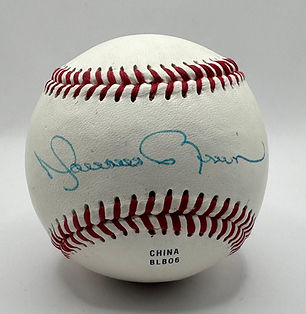
Memorabilia - Topps 1970 Nolan Ryan Card #712 (left) and a baseball autographed by Nolan Ryan (right)
SP – Randy Johnson
Randy Johnson became one of the most overpowering pitchers in MLB history, pairing elite velocity with a towering 6'10" frame that made his delivery uniquely intimidating. He won five Cy Young Awards, including four straight with the Diamondbacks, and finished his career with 4,875 strikeouts, the most by any left‑hander ever. Johnson’s dominance peaked in the early 2000s, highlighted by his co‑MVP performance in the 2001 World Series, where he helped deliver Arizona its first championship. His slider—thrown in the mid‑80s and breaking like a whip—became one of the most unhittable pitches the game has ever seen. Even into his 40s, he remained a force, throwing a perfect game at age 40 and continuing to rack up strikeouts at an elite rate. Johnson was inducted into the Baseball Hall of Fame in 2015, remembered as one of the most fearsome and dominant pitchers the sport has ever known.
Memorabilia - Randy Johnson On the Cover of SI's Baseball Issue (March 31, 1997) and a Topps 1989 Randy Johnson Card (#647)
SP – Bob Gibson
Bob Gibson built a reputation as one of the most intimidating and fiercely competitive pitchers in MLB history, dominating hitters with power, precision, and an unmatched will to win. He posted a career 2.91 ERA, won 251 games, and delivered one of the greatest seasons ever in 1968 with a 1.12 ERA, a performance so overwhelming it helped prompt MLB to lower the mound. Gibson earned two Cy Young Awards and an MVP, consistently anchoring the Cardinals’ rotation during their 1960s dynasty. In the postseason, he was even better, going 7–2 with a 1.89 ERA and throwing eight complete games in nine World Series starts. His Game 1 performance in the 1968 World Series—17 strikeouts, still a record—remains one of the most dominant outings in baseball history. Gibson was inducted into the Baseball Hall of Fame in 1981, remembered as one of the fiercest and most dominant aces the sport has ever seen.
Memorabilia - A Topps 1959 Bob Gibson Rookie Card (#514) and An Autographed Baseball with a '3,117 K's' inscription
SP – Sandy Koufax
Sandy Koufax delivered one of the most dominant peaks in MLB history, redefining what a left‑handed pitcher could be during his brief but brilliant career. He won three Cy Young Awards, an MVP, and led the league in ERA for five straight seasons, all while overpowering hitters with a devastating fastball‑curveball combination. Koufax threw four no‑hitters, including a perfect game, and routinely rose to the moment in October with a 0.95 career World Series ERA. His 1963–1966 run remains one of the greatest four‑year stretches ever, highlighted by back‑to‑back seasons with over 300 strikeouts. Chronic elbow pain forced him to retire at just 30, adding a mythical quality to his already extraordinary résumé. Koufax was inducted into the Baseball Hall of Fame in 1972, remembered as a pitcher whose peak brilliance still stands unmatched.
Memorabilia - Sandy Koufax - Topps 1964 Card (#200) and the SI Baseball Issue (April 13, 1964)
SP – Tom Seaver
Tom Seaver became the defining pitcher of his generation, combining power, command, and competitive fire to lift the New York Mets from expansion afterthought to World Series champions. He won 311 games, posted a 2.86 ERA, and struck out 3,640 hitters, all while leading the league in ERA three times and strikeouts five times. Seaver earned three Cy Young Awards and finished in the top three several other times, reflecting his remarkable consistency over two decades. His leadership and brilliance were central to the Mets’ stunning 1969 championship run, where he delivered clutch performances that helped create the “Miracle Mets” legend. Even as he aged, Seaver remained elite, throwing a no‑hitter in 1978 with the Reds and continuing to dominate well into his late 30s. He was inducted into the Baseball Hall of Fame in 1992 with a then‑record voting percentage, remembered as one of the greatest and most complete pitchers in MLB history.
Memorabilia - Tom Seaver Hall of Fame Bobble Head and an autographed baseball with a 'HOF 92' inscription.
RP – Dennis Eckersley
Dennis Eckersley crafted one of the most unique careers in MLB history, excelling first as a frontline starter before reinventing himself as a dominant, Hall of Fame closer. He saved 390 games, posted a 2.85 ERA as a reliever, and became the face of the late‑80s/early‑90s Oakland bullpen. Eckersley’s 1992 season—featuring a 1.91 ERA, 51 saves, and an almost unheard‑of 0.91 WHIP—earned him both the Cy Young Award and MVP, a rare double for a reliever. His pinpoint control and fearless mound presence made him one of the most efficient closers ever, walking just nine batters in 80 innings during that MVP season. Eckersley also delivered in October, helping the A’s win the 1989 World Series and anchoring one of the era’s most dominant pitching staffs. He was inducted into the Baseball Hall of Fame in 2004, remembered as a pitcher who mastered two roles and left a lasting imprint on both.
RP – Mariano Rivera
Mariano Rivera became the gold standard for relief pitching, pairing unmatched consistency with a calm, unshakable presence in the biggest moments. He saved 652 games, posted a 2.21 ERA, and finished with a record 205 ERA+, the most dominant run‑prevention mark ever for a long‑tenured pitcher. Rivera’s signature cutter—simple in design but devastating in execution—made him nearly unhittable for 19 seasons. His postseason résumé is even more astonishing, featuring a 0.70 ERA across 141 innings, the greatest October pitching record in MLB history. Rivera anchored five Yankees championship teams and delivered countless high‑leverage performances that defined an era of winning in New York. He was unanimously elected to the Baseball Hall of Fame in 2019, the first player ever to receive 100% of the vote, cementing his legacy as the greatest closer the sport has ever seen.
Memorabilia - Mariano Riviera Autographed Baseball and a Topps 2013 Opening Day Card #76
CP – Goose Gossage
Goose Gossage became one of the defining power relievers of the late 1970s and early 1980s, intimidating hitters with a high‑octane fastball and a fierce mound presence. He saved 310 games, posted a 2.99 ERA, and thrived in the demanding multi‑inning fireman role long before the one‑inning closer became standard. Gossage was an All‑Star nine times and played a central role in the Yankees’ 1978 championship run, delivering dominant relief work throughout the postseason. His ability to enter games as early as the sixth or seventh inning and overpower lineups set him apart from most modern relievers. Over a 22‑year career, he remained a durable, high‑leverage weapon for multiple teams, consistently excelling in pressure situations. Gossage was inducted into the Baseball Hall of Fame in 2008, remembered as one of the most intimidating and influential relief pitchers in MLB history.
Memorabilia - Topps 1979 Burger King Goose Gossage Card #10 (left) and Topps 1983 Goose Gossage card -- Both Autographed

NTSB All-Time Team skipper Sparky Anderson's lineup is star-studded and downright scary
The NTSB Lineup and Batting Order
-
Derek Jeter, SS - Sets the tone with contact, leadership, and elite situational hitting. The perfect table‑setter.
-
Pete Rose, DH - High contact rate makes him ideal for moving runners and avoiding strikeouts,
-
Lou Gehrig, 1B - Hitting in front of Ruth was a nightmare for pitchers 100 years ago. Why change anything now? RBI machine, gap‑to‑gap power, and no weaknesses.
-
Babe Ruth, RF - The most dangerous hitter ever sits exactly where he belongs—ready to break games open with one swing.
-
Hank Aaron, LF - The most consistent run producer in history. He stabilizes the heart of the order and drives in everything Jeter and Hornsby start.
-
Mike Schmidt, 3B - The greatest third baseman ever hitting sixth tells you everything about this lineup’s depth. Gold Glove defense, 548 homers, and patience.
-
Willie Mays, CF - A luxury in the seven‑spot. Power, speed, and the ability to flip the lineup over with extra‑base hits.
-
Joe Morgan, 2B - The catalyst of the Big Red Machine in 1975-76, he hit 268 homers and stole 689 bases.
-
Johnny Bench, C - A second leadoff hitter with power. Bench resets the order while controlling the running game and calling a masterpiece behind the plate.


