

My Nolan Ryan-signed 2004 All-Star Game program
Nolan's Rookie Card - Topps 1968
Card #177


Nolan Ryan Topps 1969
Card #533

Nolan Ryan Topps 1970
Card #712

Nolan Ryan Topps 1972
Card #595

Nolan Ryan Topps 1973
Card #220 (Autographed)

Sports Illustrated: May 1, 1989

My autographed Nolan Ryan California Angels jersey. He wore #30 during his stint in Anaheim from 1972-1979

Click here to see the box score from Nolan's 2nd career no-hitter (and the 2nd of his career) on July 15, 1973, in Detroit. He struck out 17, walked 4, and lowered his ERA to 2.90 in a 6-0 win over the Tigers.

My ticket from Nolan's 300th
career win in Milwaukee on
July 31, 1990. Click on the ticket to see the box score on Baseball Reference.

The Ryan Index


Sports Illustrated: April 15, 1991
Inside Sports: April 30. 1980
Sports Illustrated: June 16, 1975
The Ryan Express: Nolan Ryan Redefined Power Pitching
By Rob Olds
The North Texas Sports Blog
January 25, 2026
On the evening of July 13, 1979, as an 11-year-old Little Leaguer, I sat down to tune in to watch the New York Yankees on TV. They were in Anaheim to face the California Angels. At that point, I had been a baseball fan all of two years. I was a big fan of Reggie Jackson and was excited to see him play on the west coast. I had already seen Reggie play several times, and it always seemed that, if he wasn’t on the sports pages in the newspaper after doing something at the plate to help the Yankees win games, he was always in the headlines for one reason or another.
As the game was getting underway, the TV broadcasters were talking quite a bit about the starting time of the game. They made the point that a late afternoon/early evening start time was bad for the visiting team because the sun and the shadows it creates between home plate and the pitcher’s mound. With the shadows around home plate and the sun starting about halfway to the mound, California’s ace, Nolan Ryan, would have a distinct advantage for the first couple of innings. It’s nearly impossible for a hitter to see Ryan’s fastball when it travels from home plate in and into the shade when his velocity is hitting triple digits.
On that night, Nolan took a potential record-breaking 5th career no-hitter into the 9th inning. On June 1, 1975, he threw his 4th no-hitter against the Baltimore Orioles, tying Hall of Famer Sandy Koufax, who had dominated the previous decade with the Los Angeles Dodgers. Reggie broke up Nolan's bid with a single up the middle, and Nolan ended the night with his 7th career one-hitter.
That was the first time I saw Nolan pitch. To this very day, 47 years later, it remains one of the most memorable days I’ve ever had as a baseball fan.
Not only was I already a big fan of Mr. October, but by the end of the night, I was also excited to call myself a fan of Nolan Ryan.
That Friday night game was the start of a three-game series leading up to baseball’s All-Star break. On the following Tuesday, on July 17, Nolan started the All-Star Game for the American League. Again, I tuned in to see The Express face the best hitters in the National League. He came out of the gate strong, blowing fastballs by Davey Lopes and Dave Parker. But, he ended up allowing 3 runs on 5 hits in 2 innings that night and didn’t figure in the decision. Parker had an amazing night showing off his powerful arm off in right field by throwing out Jim Rice at third and Brian Downing at home plate and was the game’s MVP.
Nolan Ryan’s career reads like a myth stitched into the fabric of baseball history. Over 27 seasons, he became the sport’s unmatched strikeout king, piling up 5,714 strikeouts, a record so far beyond reach it makes one almost giggle. His seven no‑hitters remain the gold standard for pitching dominance, and his 12 one‑hitters show just how often he hovered on the edge of history. Ryan’s longevity alone is staggering—he pitched in four different decades, logged more than 5,300 innings, and maintained elite velocity well into his 40s, a feat that still defies belief in today’s era of pitch counts and load management.
What made Ryan extraordinary wasn’t just the numbers, though the numbers are jaw‑dropping. It was the way he overwhelmed hitters with a fastball that seemed to rise, carrying late life that hitters swore defied physics. Even as he aged, that fastball stayed in the upper‑90s, and his curveball—sharp, heavy, and vicious—gave him a second weapon that would’ve made most pitchers stars on its own. He led the league in strikeouts 11 times, posted multiple seasons with over 300 strikeouts, and set the modern single‑season record with 383 in 1973. Yet he also led the league in fewest hits allowed per nine innings multiple times, proving he wasn’t just overpowering—he was nearly unhittable.
Beyond the stats, Ryan became a symbol of toughness, work ethic, and competitive fire. He pitched through pain, took the ball every fifth day, and treated each start like a personal duel. His 7th no‑hitter at age 44, his legendary durability, and even moments like the Robin Ventura scuffle cemented him as a cultural icon as much as a baseball one. Nolan Ryan wasn’t just a great pitcher—he was a force of nature, a standard of excellence, and a reminder that greatness can be both spectacular and relentless.
Modern pitchers live in a completely different ecosystem than the one Nolan Ryan dominated, and that contrast only makes his durability look more superhuman. Today’s starters are typically capped around 90–105 pitches, often pulled at the first sign of fatigue or a third trip through the lineup. Organizations prioritize velocity, spin rate, and short‑burst dominance over the ability to work deep into games, and the rise of specialized bullpens has turned the complete game into a relic. In a typical season now, an entire league might produce fewer complete games than Ryan alone delivered in some individual years.
Because pitchers throw fewer innings, they simply don’t accumulate the counting stats that defined the great workhorses of earlier eras. Modern aces rarely reach 200 innings, let alone the 250–300‑inning workloads that were once routine for elite starters. That shift means today’s pitchers won’t come close to Ryan’s 222 complete games, his 61 shutouts, or his mountain of career innings. Even the strikeout record—once thought unbreakable but theoretically reachable in a high‑K era—is now out of reach because no pitcher will ever stay healthy long enough or pitch deep enough into games to chase it.
Nolan Ryan didn’t just redefine power pitching; he redefined what it meant to be a workhorse in a sport that no longer produces them.
This isn’t a knock on today’s pitchers; it’s a reflection of how the sport has evolved. Teams protect arms, analytics guide usage, and the game is built around maximizing efficiency rather than celebrating endurance. But when you stack that reality against Nolan Ryan’s career, it becomes clear why his records feel untouchable. He wasn’t just dominant—he was durable in a way the modern game no longer allows, a throwback to an era when greatness was measured not only by how hard you threw, but by how long you could keep throwing.

My autographed Nolan Ryan ticket from his 317th career win on July 9, 1992.
Click on the ticket to see the box score on Baseball Reference.

Visit Nolan's page on Baseball Reference. It is an excellent site where you can see his regular and postseason statistics, including his game logs, records against every hitter he faced, box scores of every game in which he pitched, and his career splits. Here is where you can visit Nolan's page at the Baseball Hall of Fame.

Legend Sports Memorabilia: January/February 1994

Legend Sports Memorabilia: Special Commemorative Issue

Heroes of the Game Magazine
Collectors Edition

The hat worn by Nolan Ryan on April 27, 1983, when he notched his 3,509th career strikeout, surpassing Walter Johnson to become the MLB all-time leader in strikeouts (photo taken at the Baseball Hall of Fame in Cooperstown, NY)
Top 20 Accomplishments of Nolan Ryan’s Career
1. MLB’s All‑Time Strikeout King — 5,714 K
Considered to be one of MLB’s most unbreakable records.
2. Seven No‑Hitters — MLB Record
More than Sandy Koufax and Justin Verlander combined.
3. 12 One‑Hitters — Tied With Feller
He flirted with no‑hitters more often than most pitchers have quality starts. He tied with fellow fireballer and Hall of Famer Bob Feller in this category.
4. 27 Seasons in MLB — Most by Any Pitcher
Longevity that borders on supernatural. Ryan was a freak of nature.
5. All‑Time Leader in Hits per 9 Innings (6.6 H/9)
Of his 222 complete games, 200 of those were starts in which he allowed 5-or-fewer hits (7 no-hitters, 12 one-hitters, 17 two-hitters, 28 three-hitters, 54 four-hitters, and 82 five-hitters). Ryan pitched in an era in which starters were allowed to finish what they started. This will never be duplicated in MLB again.
6. All‑Time Leader in Strikeouts per 9 Innings (among starters)
At the time of his retirement after the 1993 season, Ryan had struck out 9.55 per 9 innings, a Major League record.
7. 11 Seasons of 200+ Strikeouts
And six seasons over 300 — a mark most pitchers never reach once.
8. MLB Record: 383 Strikeouts in a Season (1973)
Still the modern single‑season record.
9. Inducted into the Baseball Hall of Fame (1999)
Received 98.79% of the vote — one of the highest ever.
10. Threw Two No-Hitters In 1973
Ryan threw two no-hitters @ Kansas City (May 15) and @ Detroit (July 15). In his gem against the Tigers, he struck out 17 and walked 4 in one of the most dominant outings in his long career.
11. Led the League in Strikeouts 11 Times
Including four consecutive seasons: 1987 (270) and 1988 (228) with the Houston Astros and 1989 (301) and 1990 (232) with the Texas Rangers, during his age 40-43 seasons.
12. Led the League in ERA Twice
He led the National League in ERA in 1981 (1.69) and 1987 (2.76).
13. Led the League in fewest hits per 9 innings 12 times
He set the single season record for fewest hits allowed per nine innings pitched with 5.26 in 1972, his first season with the California Angels.
14. Pitched No‑Hitter at Age 44
On May 1, 1991, Ryan threw his record 7th no-hitter, arguably the most dominant performance of his career. He struck out 16 Toronto Blue Jays while walking only 2. He struck out fellow Hall of Famer Roberto Alomar with a 95-mph fastball to end the game, a 3-0 shutout for The Express.
15. Pitched 5,386 Innings — 5th All‑Time
A workload that will never be replicated in modern baseball.
16. 324 Career Wins
Despite playing on many mediocre teams with low run support.
17. MLB Record: 2,795 Walks
A quirky record, but it underscores how unhittable he was — hitters waited him out because they couldn’t touch him.
18. Only Pitcher to Strike Out Seven Pairs of Father–Son Hitters
A testament to his longevity and dominance across generations.
19. Career WAR of 81.3 (Baseball‑Reference)
Elite by any standard — and even higher on other WAR models.
20. Set A Single Season Records With 23 Games With 10+ Strikeouts In 1973
Ryan’s high in strikeouts in ’73 (17) was on July 15 @ Detroit. He also had games with 16 K’s (1), 14 K’s (1), 13 K’s (4), 12 K’s (8), 11 K’s (3), and 10 K’s (5). His highs vs. American League teams that year included the Twins (65 K’s), Royals (46), Tigers (44), Red Sox (39), and the White Sox (35).

My ticket from Nolan's 7th no-hitter on May 1, 1991. It was one of the most dominant performances of his career--16 K's and 2 walks in a 3-0 victory over the Toronto Blue Jays. Click on the ticket to see the box score on Baseball Reference.

My autographed Nolan Ryan Houston Astros jersey. He wore #34 during his stint in Houston from 1980-1988 and with the Texas Rangers (1989-1993).
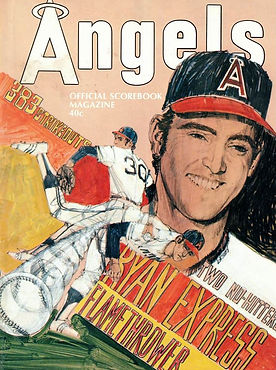
1974 California Angels Program